














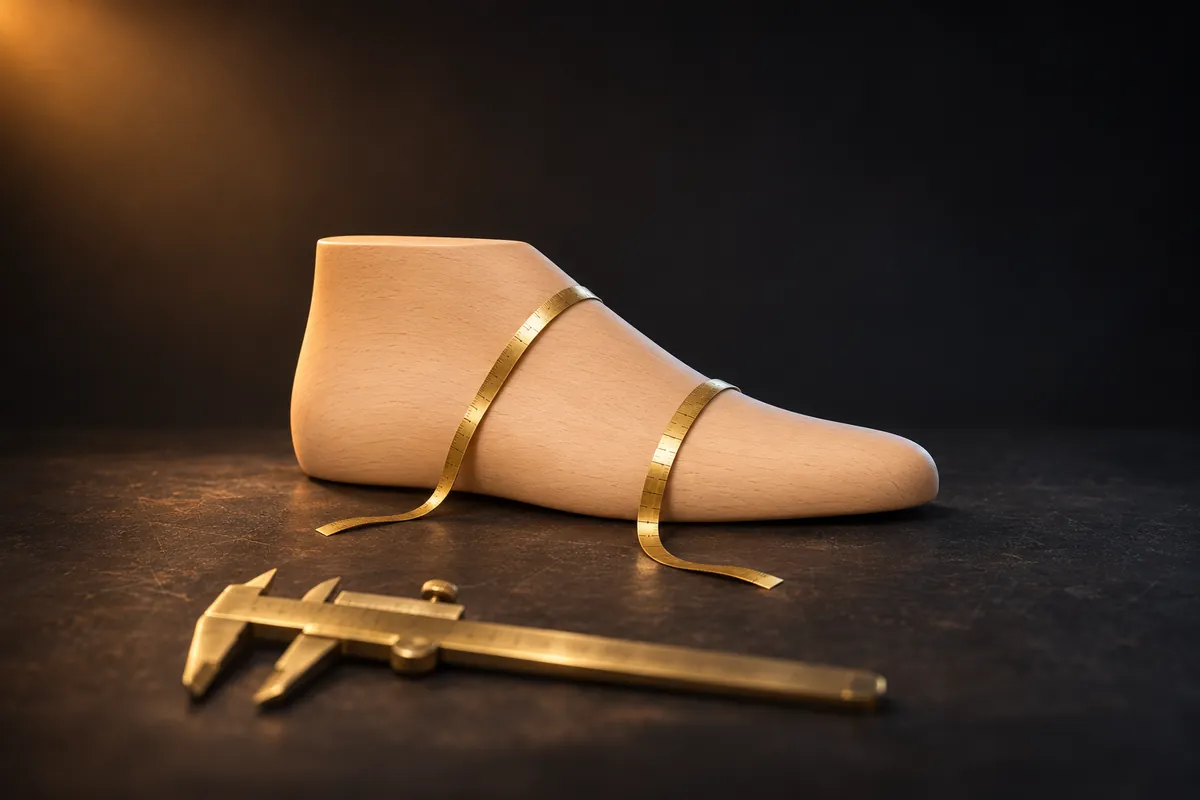
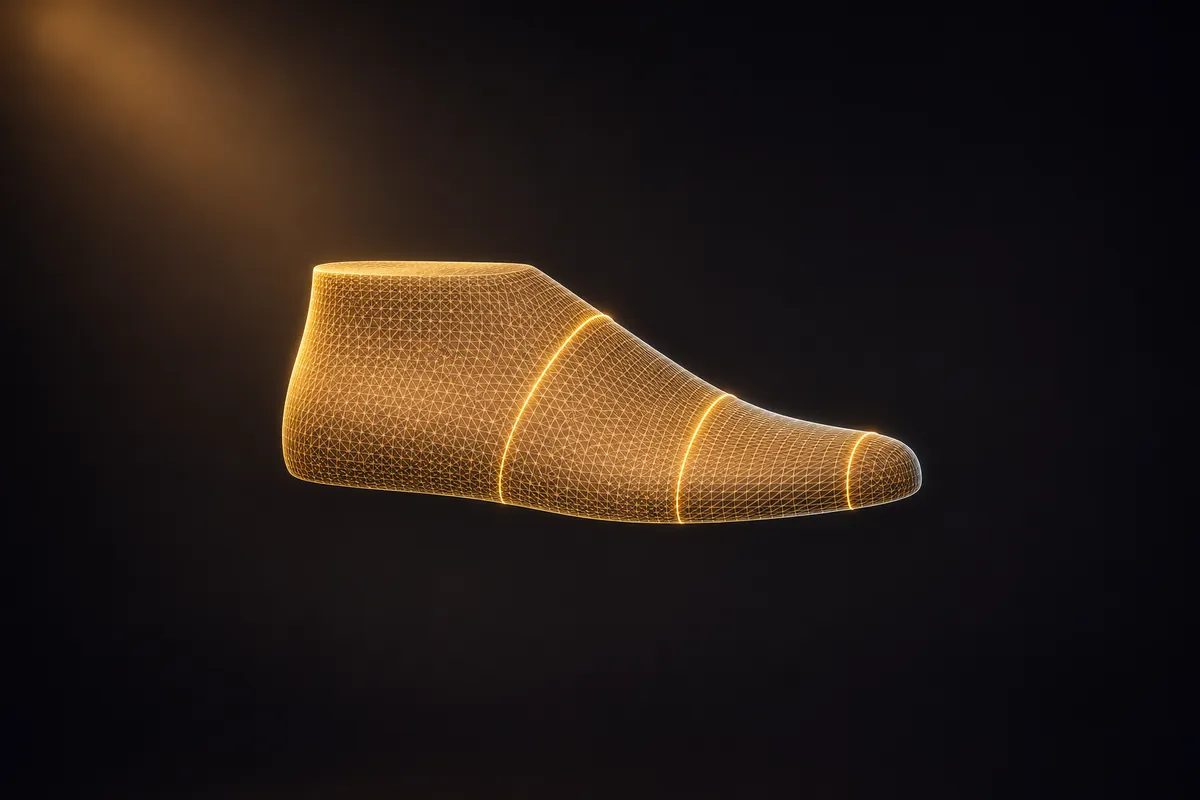




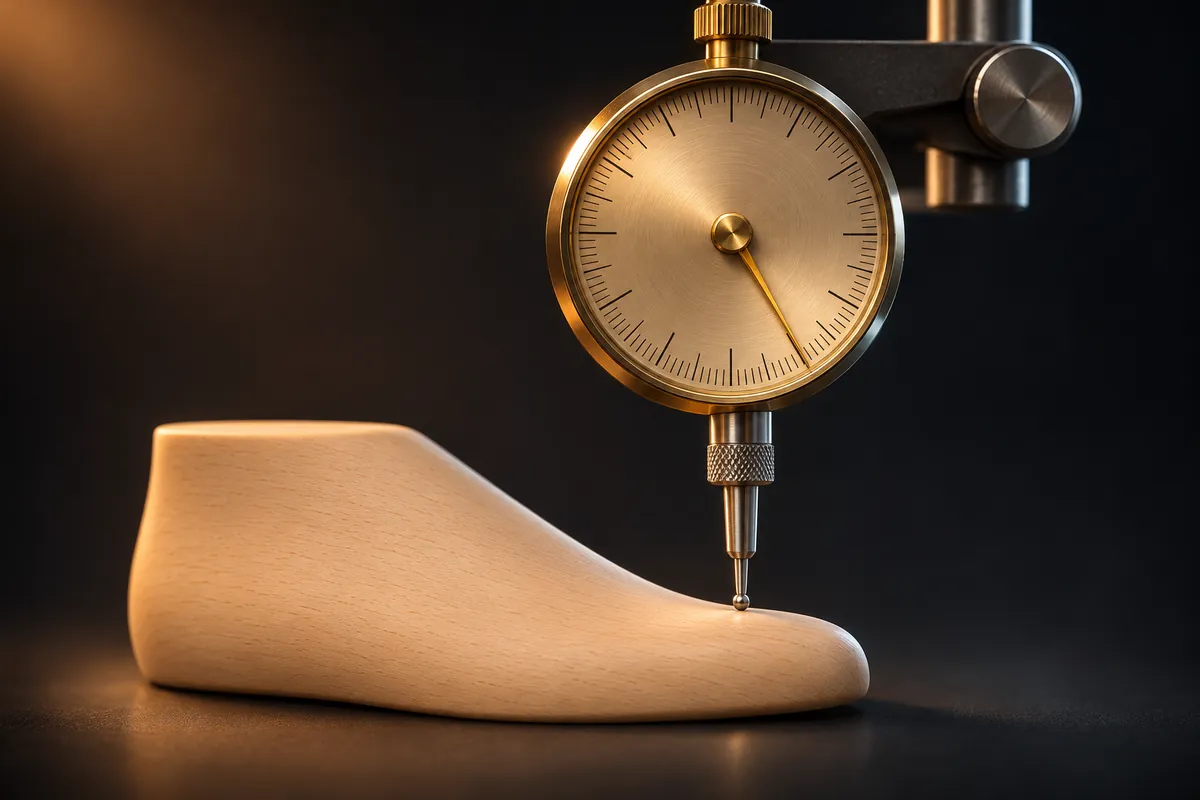

A last is a three-dimensional shape, but the conversations about it run on numbers: with the last maker, with the factory, inside the team. Ten of them come up again and again. Know what each one measures, how it goes wrong and what that does to the foot, and you can read a fit report, brief a last maker and catch a problem before the first sample.
Our platform takes 25 measurements on every last. These are the ten we would teach a new developer first.
1. Stick length
The length of the last from the back of the heel to the tip of the toe, measured the way a last maker’s size stick does. It sets the size: in French (Paris point) sizing, one size is 6.66 mm of last length; in English and US sizing, 8.46 mm.
The last is always longer than the foot it fits. CTC, the French technical center for leather and footwear, recommends an allowance of about 5% for a closed shoe and 2% for a sandal. Too short, and the toes hit the end of the shoe as it rolls off the ground. Too long, and the ball of the foot no longer sits where the shoe bends.
2. Ball girth
The circumference around the ball of the last, over the joints of the big toe and the little toe. It is the most important fit number on a last, because it defines the width fitting. In French sizing the ball girth grows 5 mm from one size to the next, and width fittings are 5 mm apart; English widths are a quarter of an inch (6.35 mm) apart.
The forefoot takes a little compression, so a last is built slightly tighter than the foot: CTC’s rule of thumb is a ball girth about 5% below the foot’s. Too tight, and the joints rub. Too loose, and the foot slides forward, the toes jam and the heel slips.
3. Instep girth
The circumference around the instep, over the top of the foot behind the ball. Here the rule is the opposite of the ball: bone and veins sit right under the skin, so the instep must never be compressed. The last should match the foot there, or be slightly larger.
An instep that is too tight hurts within the hour. One that is too loose leaves nothing to hold the foot back in the heel, which shows first in pumps and loafers, where no laces take up the slack.
4. Toe girth
The girth across the toe box, in front of the ball. Fashion shapes the toe; the toes don’t change. Narrow and pointed designs are where toe girth drifts first, and where a few millimeters decide whether the shoe can be worn all day.
5. Ball width
The width across the bottom of the last at the ball: the tread the foot stands on. The bottom of the ball section is about a third of the ball girth, so when the girth grows 5 mm from one size to the next, the bottom grows about 1.66 mm and the upper takes the rest.
Too narrow, and the foot rolls over the edge of the sole and the upper bulges. Too wide, and the foot slides from side to side.
6. Seat width
The width of the heel seat, the back of the last the heel sits in. The seat is what holds the foot in the shoe. Too wide, and the heel slips out with every step; too narrow, and the sides of the heel are pinched.
7. Heel height
The height the last is built to stand at, measured under the back of its bottom edge. Many last makers prefer the shank height, measured a set distance forward (25 mm on women’s lasts, 30 mm on men’s), because it varies less from one back curve to another.
Heel height changes everything else: as the heel rises, the back of the foot lengthens and the weight moves forward. So the order matters. Place the tread point first (number 10), then read the heel height. Never tilt the last until the toe spring looks right and read the height afterwards.
8. Toe spring
How high the tip of the toe stands off the ground when the last sits at its heel height. It has no fixed value, but every shoe needs some: without it, the toe drags as the foot rolls forward, wears out early and can trip the wearer. High heels want a little more; rigid soles and platforms want a lot more.
9. Toe height
The height inside the front of the toe box, over the toes. It is a one-sided measurement: too low crushes the toes and presses on the nails within hours, while a little extra room rarely hurts anyone. That is how we grade it: we flag a toe box that is too thin, never one that is a little generous.
10. The tread point
Where the last meets the ground at the front: on a flat last, the point halfway between the joints of the big toe and the little toe. The line between those two joints runs at an angle, the big toe’s joint further forward, and the shoe has to bend along it.
Place the tread point wrong and the shoe bends in the wrong place: creases across the toes, a heel that lifts out, pressure on the joints. It is also the reference for the heel height (number 7).
Beyond the ten
Boots add two girths: the short-heel girth, from the back of the heel over the instep, which decides whether the foot can get in at all, and the ankle girth.
And no list of single numbers is the whole story. Two lasts can share the same ball, instep and toe girths and still fit differently, because what happens between those sections matters too. That is why we also compare the whole girth profile of a last, section by section, with the standard’s.
Read them against a standard
A measurement means little on its own. A 240 mm ball girth is right for one size and kind of shoe and wrong for another. Each number needs an ideal for that size, that width and that shoe type, and a tolerance around it. That is what a fit report gives you: for every measurement, the measured value, the ideal, the tolerance band and a grade.
Want to see the ten on your own last? Send us one: we’ll measure it and walk you through its fit report.